

That new brown spot on your hand. Is it just a sign of getting older, or something more serious? One in five Americans will develop skin cancer in their lifetime, so your concern makes sense. The tricky part? Age spots and skin cancer can look remarkably similar.
This guide breaks down exactly how to tell them apart so you know when to relax and when to act fast.
In this article, you’ll learn:
- What age spots actually are and why they form
- Key visual differences between benign spots and cancerous growths
- How to use the ABCDE rule for self-examination
- Warning signs that require a dermatologist visit
- Prevention strategies to protect your skin going forward
At Natura Dermatology, our team performs comprehensive skin exams to catch concerning spots early. If something on your skin has you worried, our Fort Lauderdale providers can give you a clear answer.
What Age Spots Actually Are and Why They Form
Age spots go by many names. Solar lentigines, liver spots, sun spots. Whatever you call them, they’re all the same thing: flat, dark patches that typically develop on sun exposed areas of your skin.
The Science Behind the Spots
Age spots are caused by overactive pigment cells. Ultraviolet (UV) light speeds up the production of melanin, a natural pigment that gives skin its color. Over years of frequent sun exposure, this excess melanin production causes visible changes.
Here’s what happens at the cellular level: UV radiation triggers your pigment producing cells (called melanocytes) to go into overdrive. On skin that has had years of sun exposure, age spots appear when melanin becomes clumped or is produced in high concentrations.
Unlike freckles, which typically fade during winter months, age spots stick around regardless of the season. They may darken slightly with additional sun damage, but they won’t disappear on their own.
Where They Typically Develop
Age spots show up on places exposed to the most sun exposure throughout your lifetime:
- Face and forehead
- Back of the hands
- Shoulders and upper back
- Forearms
- Tops of feet
Age spots are very common in adults older than 50, but younger people can get them if they spend time in the sun. People with light skin, fair skin, or a sun exposure history of outdoor work or activities are at higher risk.
Are Age Spots Dangerous?
No. Harmless age spots pose no threat to your skin health. They’re purely a cosmetic concern. However, they are a sign that your skin has accumulated significant UV damage over time, which means you should be vigilant about other skin changes.
If you want to treat age spots for cosmetic reasons, topical treatments like retinoids or hydroquinone can help. Laser therapy, chemical peels, and cryotherapy are also effective options. But medically? They don’t require any intervention.
Key Visual Differences Between Benign Spots and Cancerous Growths

Understanding the difference between age spots and skin cancer could save your life. Here’s how to tell the difference at a glance.
Age Spots: What “Normal” Looks Like
Harmless age spots share a consistent set of characteristics:
| Feature | Age Spot Characteristics |
|---|---|
| Shape | Round or oval |
| Border | Smooth, well defined edges |
| Color | Uniform light brown, medium brown, or dark brown |
| Texture | Flat and smooth to the touch |
| Size | A few millimeters to about one inch |
| Change | Stable over time |
Age spots are generally harmless and don’t itch, bleed, or cause discomfort. They blend naturally with your skin tone, just darker.
Skin Cancer: Red Flags to Watch
Unlike age spots, skin cancer spots and skin cancer lesions have their own characteristics that set them apart. Here’s what each type of skin cancer may look like:
Basal Cell Carcinoma
The most common type of skin cancer. Basal cell carcinoma often appears as:
- A pearly or waxy bump
- A flat, flesh-colored or pinkish scar-like lesion
- A bleeding or scabbing sore that heals and returns
Squamous Cell Carcinoma
This type of skin cancer typically shows as:
- A firm, red nodule
- A flat lesion with a scaly, crusted surface
- A rough patch that may bleed easily
Melanoma
The most dangerous form. Melanoma lesions often display:
- Multiple colors within one spot (brown, black, red, white, or blue)
- Irregular borders or poorly defined borders
- Asymmetrical shape where one half doesn’t match the other
- A diameter larger than a pencil eraser
- Dark patches that change over time
The Texture Test
The biggest difference between harmless age spots and sun spots (actinic keratoses) is the texture. Age spots are smooth and flat, but potentially dangerous actinic keratoses usually feel rough and scaly.
Run your finger over the spot. If it feels like sandpaper, that’s a warning sign.
Don’t Forget Actinic Keratosis
Actinic keratosis deserves special attention. AKs result from long-term exposure to ultraviolet (UV) radiation. This puts you at a higher risk for skin cancer, since AKs can develop into squamous cell carcinoma (SCC).
These precancerous growths often appear as dry, scaly patches on sun exposed skin. They can be red, tan, pink, or skin-colored. If you notice rough spots that won’t go away, seek medical advice promptly.
How to Use the ABCDE Rule for Self-Examination
The ABCDE rule is a simple framework dermatologists developed to help you identify potential melanoma during regular self checks. Memorize it.
A is for Asymmetry
Draw an imaginary line through the center of the spot. Do both halves match? Normal moles and age spots are symmetrical. If one half looks different from the other, that’s a red flag.
B is for Border
Examine the edges. Age spots have smooth, well defined edges that are easy to trace. Skin cancer often has:
- Jagged or notched borders
- Blurry or faded edges
- Irregular outlines that are hard to define
C is for Color
Age spots are typically one uniform shade of brown, tan, or sometimes black. Suspicious spots often contain:
- Different shades within the same lesion
- Multiple colors like brown, black, red, white, or blue
- Uneven color distribution
D is for Diameter
Melanomas are often larger than 6 millimeters, roughly the size of a pencil eraser. However, this isn’t a hard rule. Some melanomas start smaller, so don’t ignore a spot just because it’s tiny.
E is for Evolving
This might be the most important letter. Age spots remain stable over time. Skin cancer evolves. Watch for:
- Changes in size, shape, or color
- New symptoms like itching, bleeding, or crusting
- A spot that looks different than it did a few months ago
Pro Tip:Take photos of any spots that concern you and date them. Comparing images over time makes it much easier to detect subtle changes.
The “Ugly Duckling” Sign
Here’s another trick: look for the spot that doesn’t belong. Most of your moles and spots probably share a similar appearance. If one stands out as noticeably different from the rest, have it examined by a board certified dermatologist.
Warning Signs That Require a Dermatologist Visit
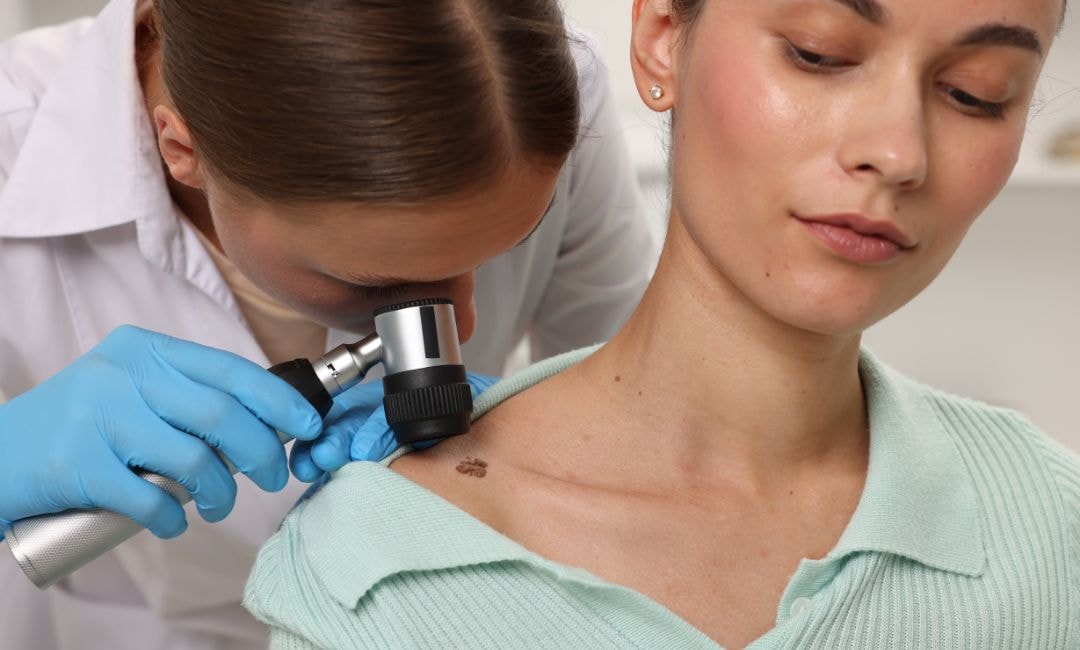
Some skin changes demand professional evaluation. Don’t wait if you notice any of the following:
Immediate Red Flags
- A spot that bleeds without injury
- A sore that won’t heal after several weeks
- A growth that itches, burns, or feels tender
- Any dark spot with poorly defined borders
- A lesion with multiple colors
- A new skin growth that appeared suddenly and keeps expanding
Changes in Existing Spots
Even if you’ve had a spot for years, pay attention to:
- Size increase
- Color changes or new colors appearing
- Border becoming irregular
- Texture shifting from smooth to rough or scaly
- Elevation changes (flat spot becoming raised)
High-Risk Individuals
Some risk factors mean you should be extra vigilant and consider more frequent skin exams:
- Fair skin that burns easily
- Blond or red hair with light eyes
- Personal history of skin cancer
- Family history of melanoma
- History of severe sunburns, especially in childhood
- Prolonged sun exposure from outdoor work or activities
- Use of tanning beds
- Weakened immune system
- Older age (50+)
- Large number of moles (50 or more)
When in Doubt, Get It Checked
The five-year survival rate for patients with stage 0 melanoma is 97%, compared to 10% for those with stage 4 melanoma.
Early detection makes all the difference. If a spot concerns you, don’t wait months hoping it goes away. A quick visit to a dermatologist can provide peace of mind or catch something serious while it’s still treatable.
At Natura Dermatology, we perform comprehensive skin exams that cover your entire body, including areas you can’t easily see yourself. Dr. Will Richardson and our team specialize in identifying suspicious lesions and providing effective treatment when skin cancer is found.
Prevention Strategies to Protect Your Skin Going Forward
You can’t undo past sun damage, but you can prevent further harm. These strategies help maintain healthy skin and reduce your risk of both age spots and skin cancer.
Sun Protection Essentials
Use Broad Spectrum Sunscreen Daily
Apply sunscreen with SPF 30 or higher every single day, even when it’s cloudy. UV radiation penetrates clouds and can cause skin damage year-round. Apply it 15 to 30 minutes before sun exposure, and reapply every two hours when outdoors.
Don’t forget commonly missed areas:
- Ears and neck
- Back of hands
- Scalp (if thinning hair or bald)
- Tops of feet
Wear Protective Clothing
Clothing provides a physical barrier against harmful UV rays. For best protection:
- Choose tightly woven fabrics
- Wear long sleeves and pants when possible
- Add a wide-brimmed hat (at least 3 inches)
- Use UV-blocking sunglasses
Look for clothing with a UPF (Ultraviolet Protection Factor) rating of 50+ for maximum defense.
Limit Sun Exposure During Peak Hours
UV radiation is strongest between 10 a.m. and 4 p.m. If you can, schedule outdoor activities for early morning or late afternoon. When you must be outside during peak hours, seek shade whenever possible.
Avoid Tanning Beds
There’s no such thing as a safe tan. Tanning beds emit concentrated UV radiation that accelerates skin damage and dramatically increases your risk of skin cancer. Use of commercial tanning lamps and beds also can cause age spots. Skip them entirely.
Protect Against Environmental Pollutants
UV radiation isn’t the only threat. Environmental pollutants can also contribute to premature aging and skin damage. Use antioxidant-rich skincare products to help neutralize free radicals and support your skin’s natural defenses.
Schedule Regular Skin Exams
Self-exams are valuable, but they have limits. A board-certified dermatologist can spot things you might miss, especially in hard-to-see areas like your back, scalp, and behind your ears.
The American Academy of Dermatology recommends:
- Monthly self-exams at home
- Annual professional skin exams (more frequently if you have risk factors)
What About Existing Age Spots?
If you already have age spots and want to minimize their appearance, several options exist:
- Topical treatments: Retinoids, hydroquinone, vitamin C serums
- Chemical peels: Remove the outer layer of damaged skin
- Laser therapy: Targets melanin to break up dark pigmentation
- Cryotherapy: Freezes individual spots with liquid nitrogen
- Microdermabrasion: Exfoliates the skin surface
These treatments can help improve skin color and reduce the visibility of dark spots. However, prevention remains the best strategy. Diligent sun protection can stop new spots from forming and may even help existing ones from darkening further.
Know Your Skin With Natura Dermatology
The difference between age spots and skin cancer isn’t always obvious. What looks like a harmless liver spot could be something that needs attention. What seems alarming might turn out to be completely benign. The only way to know for sure is through a professional evaluation.
Key takeaways:
- Age spots are flat, uniformly colored, and stable over time
- Skin cancer often shows irregular borders, multiple colors, and changes over time
- The ABCDE rule helps identify suspicious moles during self-exams
- Actinic keratosis is a precancerous condition that feels rough and scaly
- Early detection dramatically improves skin cancer treatment outcomes
- Daily sun protection prevents both age spots and skin cancer
At Natura Dermatology, our mission is ensuring no one dies from melanoma through thorough full-body imaging and exams. If you’ve noticed a new spot, or you’re overdue for a skin check, our Fort Lauderdale team is here to help. Dr. Will Richardson and our providers offer comprehensive screenings that catch problems early, when they’re most treatable. Schedule your skin exam today.
FAQs
What do cancerous age spots look like?
Cancerous spots differ from harmless age spots in several ways. Look for asymmetrical shapes, irregular or poorly defined borders, multiple colors within one spot, and a diameter larger than a pencil eraser. Unlike age spots, cancerous growths often change over time. They may bleed, itch, or develop a scaly texture. If a spot evolves in any way, have it examined.
Can cancer cause a rash?
Yes, certain skin cancers can resemble a rash. Squamous cell carcinoma sometimes appears as a red, scaly patch that won’t heal. Inflammatory breast cancer can cause rash-like changes on the chest. Some skin conditions like mycosis fungoides, a type of skin lymphoma, also mimic eczema or psoriasis. Any persistent rash that doesn’t respond to treatment deserves evaluation by a dermatologist.
How to tell if a sunspot is cancer?
The key differences are texture, borders, and stability. Benign sun spots are smooth, flat, and uniform in color. Cancerous or precancerous spots often feel rough or scaly when you touch them. They may have blurry edges, contain multiple shades, or change over time. If a spot bleeds easily, keeps crusting over, or grows rapidly, seek medical advice. When treated early, most skin cancers have excellent outcomes.
Can you get melanoma on your calf?
Absolutely. Melanoma can develop anywhere on your body, including areas not regularly exposed to the sun. The calf is actually a common location, especially in women. Check your legs regularly during self-exams. Look for new moles, existing moles that change, or dark spots with irregular features. Any skin type can develop melanoma, though fair-skinned individuals face higher risk.
How do you know if a child has melanoma?
Melanoma is rare in children, but it does occur. In kids, melanoma often looks different than in adults. Watch for a mole that’s raised, has an uneven surface, bleeds easily, or appears different from other moles.
Children’s melanomas may be pink or red rather than dark brown. The “ugly duckling” sign applies here too. Any new or changing spot on a child’s skin warrants prompt evaluation by a pediatric dermatologist.
What can be mistaken for sun spots?
Several skin conditions mimic sun spots, including seborrheic keratosis (raised, waxy growths), actinic keratosis (rough, scaly precancerous patches), and even early stages of melanoma. Freckles, cherry angiomas, and certain fungal infections can also look similar. The only way to confirm what you’re dealing with is through professional examination. When in doubt, get it checked.
How do you know if brown spots on your face are cancerous?
Apply the ABCDE rule. Check for asymmetry, border irregularity, color variation, diameter over 6mm, and evolution over time. Pay attention to texture. Smooth, flat spots are usually benign. Rough, scaly, or raised spots need evaluation.
Also watch for spots that bleed, itch, or won’t heal. Maintaining skin health includes regular self-exams and annual screenings with a dermatologist, especially for areas frequently exposed to the sun like your face.


