

That itchy spot on your arm won’t go away. You’ve tried lotion, changed soaps, and ignored it for weeks. But it’s still there.
About 40% of skin cancer patients report itching as an early symptom, yet most people dismiss it as dry skin or allergies. The reality? Itching can be your body’s first warning that something serious is developing. While not every itch signals cancer, persistent itching in the same spot, especially when paired with visible changes, demands attention. We’re breaking down exactly when itching matters and what to do about it.
Here’s what we’ll cover:
- Which types of skin cancer commonly cause itching and why
- The difference between normal itching and cancer-related itching
- Other warning signs that appear alongside itching
- When an itchy spot requires immediate medical evaluation
- What happens during a skin cancer screening
At Natura Dermatology & Cosmetics in Fort Lauderdale, Dr. Will Richardson evaluates suspicious skin changes daily. Our Mohs surgery expertise and comprehensive skin cancer screenings help catch problems early when they’re most treatable.
Which Skin Cancers Actually Itch
Not all skin cancers announce themselves the same way. Some bleed. Some change shape. And some? They itch like crazy.
Research shows that roughly 37% of non-melanoma skin cancers cause itching, but the numbers vary wildly depending on which type you’re dealing with.
Basal Cell Carcinoma (The Sneaky Itcher)
Basal cell carcinoma (BCC) typically shows up on sun-exposed areas like your face, head, neck, and arms. It’s the most common skin cancer in the U.S., accounting for millions of new cases every year.
Here’s what makes BCC different: about 21% to 31% of BCCs cause itching, and when they do, the itch stays localized right where the tumor sits.
Why does it itch?
BCC grows in the upper layers of your skin, where it can damage nerve endings, triggering that maddening itch sensation. Think of it like this: basal cells live close to the surface. When cancer develops there, it messes with the fine network of nerves just beneath your skin.
The itch usually feels moderate, not the kind that wakes you up at night. Most patients rate it around 3 out of 10 on the intensity scale.
What it looks like:
- Shiny, translucent bump (often pearly white or pink)
- Small blood vessels that you can see through the skin
- An open sore that won’t heal or keeps coming back
- Flat, pale patch that resembles a scar
If you’ve noticed a spot that itches and matches any of these descriptions, Natura Dermatology’s team can evaluate it during a comprehensive skin exam. Dr. Will Richardson uses advanced diagnostic techniques to catch BCCs early when they’re easiest to treat.
Squamous Cell Carcinoma (The Chronic Scratcher)
Squamous cell carcinoma (SCC) takes the crown for itchiness, with studies showing 45% to 47% of cases cause uncomfortable itching. That’s nearly half.
SCC often triggers chronic itching, especially as it grows or spreads. The underlying mechanism is inflammation around the cancerous cells, which irritates the surrounding tissue and creates that persistent itch.
What makes SCC different from BCC:
While BCC lives in the superficial layers and causes itch, SCC can grow deeper and trigger both itching and pain. If a lesion is itchy and painful together, dermatologists recommend removal even if it doesn’t look obviously cancerous.
Common warning signs:
- Rough, scaly red patches that crust or bleed
- Wart-like growths
- Open sores that don’t heal within a few weeks
- Raised bumps with a central depression
The team at Natura Dermatology sees patients with suspicious SCCs regularly. If caught early, treatment options like Mohs surgery can remove the cancer with minimal scarring while preserving healthy tissue.
Melanoma (The Rare Exception)
Here’s where things get interesting. The “itchy melanoma mole” is mostly a myth. Research shows melanoma doesn’t typically cause itching.
Only about 15% of melanomas cause any itching at all, making it the least itchy of the major skin cancers.
But here’s the catch: when a mole starts itching, growing, or changing color, it could signal melanoma, the deadliest form of skin cancer.
The ABCDE rule still matters:
- Asymmetry (one half looks different)
- Border (irregular or jagged edges)
- Color (multiple colors or uneven tones)
- Diameter (larger than a pencil eraser)
- Evolving (changing size, shape, or color)
When melanoma does cause itching, you’ll often notice redness or irritation around the lesion because your immune system is reacting to abnormal cells.
Natura Dermatology offers full-body skin cancer screenings where providers examine every mole and mark with precision. Early melanoma detection dramatically improves survival rates.
Actinic Keratosis (The Pre-Cancer Warning)
Actinic keratosis (AK) is a precancerous skin change that can develop into squamous cell carcinoma, and it may also itch. You might feel an AK before you see it, as a rough, crusty, or scaly area.
Think of AKs as yellow warning lights on your skin’s dashboard. They’re telling you damage has occurred, but you still have time to act.
Pro tip:If you run your hand across your face or scalp and feel rough patches that won’t go away, book a screening. Treating AKs before they progress into SCC is far easier than dealing with full-blown cancer later.
How Cancer-Related Itching Feels Different

You might wonder, “Does skin cancer itch like a bug bite?” While the two can feel similar at first, there are significant differences. That persistent itch on your forearm isn’t necessarily cancer, but knowing what sets cancer-related itching apart could save your life.
The Bug Bite Test
Bug bites typically go away on their own, but an itchy spot caused by skin cancer often lingers, changes in color or size, crusts, or bleeds easily.
Here’s a simple comparison:
- Bug bites itch intensely for 3-7 days, then fade. They respond to anti-itch cream. They’re usually raised welts that you can remember getting.
- Cancer-related itching sticks around for weeks or months. It doesn’t respond well to over-the-counter treatments. The itchy area often looks abnormal.
Dr. Richardson at Natura Dermatology explains it like this: if you’ve been scratching the same spot for six weeks and can’t figure out why, it’s time to book a screening.
Duration Is the Dead Giveaway
An itch that lasts six weeks or longer is known as chronic pruritus. In rare cases, chronic pruritus can be a sign of cancer.
Six weeks. That’s your mental timer.
Most benign causes of itchy skin (dry skin, seasonal allergies, or reactions to new laundry detergent) resolve within days or a couple of weeks with basic treatment. But itching that lasts four to six weeks without improvement should be checked out.
Pro tip: Keep a log if you’re dealing with persistent itching. Note when it started, where it’s located, what makes it worse, and whether any visual changes accompany it. This information helps dermatologists during evaluations.
Location Matters
Cancer-related itching can be localized (affecting one area of the body) or generalized (affecting the entire body).
For nonmelanoma skin cancers like basal cell and squamous cell carcinoma, the itch stays right where the cancer is. About 21% to 31% of basal cell carcinomas cause itching that remains localized to the tumor itself.
Contrast that with other conditions:
- Dry skin itches all over, especially in winter
- Eczema tends to hit elbows, knees, and creases
- Allergic reactions spread across multiple areas
If you’ve got one stubborn, itchy spot that won’t quit, pay attention.
The Texture Factor
Cancer-related itching might occur alongside changes in texture. The spot might become thicker or develop a rough surface as cells multiply abnormally.
Run your fingers across the itchy area. Does it feel different from the surrounding skin? A scaly patch, raised bump, or pearly bump that also itches deserves professional evaluation.
Pain and tenderness are more commonly associated with skin cancer than itchy skin, but cancer can potentially irritate the fine nerve endings in the skin and cause an itching sensation.
Natura Dermatology offers same-day appointments for suspicious lesions. Their providers can distinguish between harmless skin conditions and early cancer during a thorough examination.
When Other Symptoms Tag Along
Itching linked to cancer often has certain characteristics. Typically, it doesn’t include a rash or hives, and happens in response to water or without explanation.
Watch for “aquagenic itch,” which develops minutes after contact with water. This can signal certain blood cancers or internal issues, though it’s less common with skin cancer itself.
The big picture: if your itch comes with zero obvious trigger and standard treatments fail, that’s your cue to get checked.
Red Flags That Demand Attention
Itching rarely shows up solo when cancer’s involved. Skin cancer often comes with other visible or sensory changes that may signal something more serious than a minor irritation.
Here’s what to watch for alongside that stubborn itch.
The Non-Healing Sore
An open sore that doesn’t heal and may bleed, ooze, or crust is a common symptom. The sore might persist for weeks, or appear to heal and then come back.
Think about normal cuts. They scab over and disappear within a week or two.
Cancer doesn’t follow that script. Normal wounds heal within a week or so, but open sores from skin cancer may have oozing, bleeding, or crusting for more than four weeks, or may be a lesion that heals and then returns.
One of Natura’s patients noticed a “pimple” on her nose that kept bleeding when she washed her face. Three months later, it was still there. Turned out to be basal cell carcinoma, completely treatable because she didn’t wait.
Bleeding Without Cause
Basal cell cancers are often fragile and might bleed after shaving or after a minor injury.
You barely touch the spot and it bleeds. Or it spontaneously oozes without any trauma. Small ulcers or nodules that bleed spontaneously, even with gentle wiping, can point to advanced basal or squamous cell carcinoma.
This happens because cancer cells grow abnormally and create fragile tissue that breaks down easily. The blood vessels in these areas are poorly formed and prone to rupture.
If you’re constantly finding blood on your towel from the same spot, don’t chalk it up to clumsiness.
Color Changes and Uneven Pigmentation
The ABCDE rule helps recognize the warning signs of melanoma. Color changes include spots that are not the same all over and may include shades of brown, black, pink, red, white, or blue.
- A stands for Asymmetry (one half doesn’t match the other)
- B means Border irregularity (ragged or blurred edges)
- C flags Color variation (multiple shades)
- D indicates Diameter over 6mm (pencil eraser size)
- E signals Evolving (changing in any way)
That last one is critical. Any change in size, shape, color, or new symptoms such as bleeding, itching, or crusting may be a warning sign of melanoma.
Natura Dermatology uses digital dermoscopy to track suspicious moles over time. This technology captures high-resolution images that reveal subtle changes human eyes might miss.
The Scaly, Crusty Appearance
A rough or scaly red patch, which might crust or bleed, is a sign of skin cancer. These patches often show up on sun-damaged skin and feel like sandpaper under your fingers.
Actinic keratosis shows up as a scaly or crusty bump on the skin’s surface and is usually dry and rough. While AK isn’t cancer yet, it’s considered precancerous and can develop into squamous cell carcinoma if left untreated.
Run your hand across your face, ears, or scalp. Feel any rough patches that weren’t there before? Get them evaluated.
Rapid Growth or Expansion
A new, expanding, or changing growth, spot, or bump on the skin requires medical evaluation.
Speed matters. Most benign moles and spots stay relatively stable. Cancer cells multiply aggressively.
If that itchy spot has doubled in size over a few months or is noticeably larger than it was last season, that’s a red flag worth investigating.
Pain, Tenderness, or Burning
While we’re focused on itching, some skin cancer spots can itch and burn. These sensations are often mistaken for psoriasis, infections, or irritation, but unlike those conditions, the discomfort tends to persist and may worsen.
Squamous cell carcinoma can grow deeper and trigger both itching and pain. If a lesion is itchy and painful together, dermatologists recommend removal even if it doesn’t look obviously cancerous.
The “Pearly” or Translucent Look
Basal cell carcinoma can feel like a pearly bump or sore. This shiny, translucent appearance is a telltale sign that separates BCCs from other skin conditions.
You might see a shiny bump or nodule that is pearly or translucent and often pink, red, or white. Sometimes it can be tan, black, or brown, and may appear as a small pink growth with a slightly raised, rolled edge and a crusted indentation in the center.
These pearly bumps often have visible blood vessels threading across the surface. Look closely.
When to Stop Googling and Call
You need a cancer diagnosis consultation if you notice:
- Itching in the same spot for more than 6 weeks
- Any spot that bleeds easily or won’t heal
- Changes to existing moles (size, color, border, symmetry)
- New growths that look different from your other moles
- Multiple warning signs appearing together
See a doctor if you have persistent itchy skin and you develop other concerning symptoms. They can figure out what’s causing the symptoms and get you the proper treatment.
Certain internal cancers can also cause itchy skin. Cancers that may block the bile duct include liver cancer, pancreatic cancer, gallbladder cancer, and bile duct cancer. High levels of bilirubin can cause itchy skin and jaundice. While less common, kidney disease can also trigger persistent itching.
At Natura Dermatology & Cosmetics, the team screens patients with suspicious symptoms using advanced diagnostic tools. Early detection transforms outcomes. Dr. Will Richardson performs comprehensive full-body exams that catch cancers at their most treatable stages.
When That Itchy Spot Needs Immediate Evaluation
Not every itchy skin cancer situation requires dropping everything and rushing to the emergency room. But some do.
Here’s how to know when you need to act fast.
The Two-Week Rule
In general, any new or changing spots on your skin that persist for two weeks or more should be brought to your doctor’s attention.
Two weeks is your baseline. If you’ve been scratching the same spot for longer than that with no improvement, schedule an appointment.
But certain situations demand faster action.
Rapid Changes Require Same-Week Appointments
Patricia noticed a spot on her leg where the skin was starting to change quickly and become red and irritated. She didn’t wait. She scheduled an appointment as soon as she returned from vacation.
Smart move.
Watch for:
- A mole that’s grown noticeably larger in weeks (not months)
- Sudden color changes (darkening, multiple colors appearing)
- Itching that becomes increasingly intense
- Spontaneous bleeding from the itchy area
- Rapid development of crusting or scabbing
If an appointment is not available within a week or two, even after explaining that you are concerned about melanoma, seek another physician’s office.
Don’t let scheduling delays become medical delays. If your regular dermatologist can’t see you quickly, find someone who can.
At Natura Dermatology, Dr. Richardson prioritizes urgent cases. Patients with rapidly changing moles or suspicious symptoms often get same-day or next-day appointments.
Family History Changes the Equation
Regular skin self-exams are especially important for people with a strong family history of skin cancer. Your doctor will ask if you or anyone in your family has had skin cancer.
Having a parent or sibling with melanoma puts you at significantly higher risk. Annual skin exams may be especially recommended for anyone who has a first-degree relative (parents, siblings, children) who has or had melanoma.
If your family history includes skin cancer and you notice an itchy, changing mole, don’t wait the standard two weeks. Get evaluated within days.
Blair Ferguson at Natura Dermatology notes that patients with a family history often benefit from more aggressive monitoring schedules, sometimes every six months instead of annually.
Multiple Warning Signs = Urgent Appointment
One symptom might be nothing. Multiple symptoms together? That’s your alarm bell.
See a doctor if you have persistent itchy skin and you develop other concerning symptoms. Skin cancer often has no symptoms in its early stages, though symptoms can appear at any point.
Book an urgent appointment if your itchy spot also has:
- Irregular borders (jagged, blurred, or notched edges)
- Asymmetry (one half doesn’t match the other)
- Multiple colors in the same lesion
- Diameter larger than a pencil eraser
- Bleeding or oozing without trauma
Make an appointment to see a healthcare provider or dermatologist as soon as you notice any changes to your skin or changes in the size, shape, or color of existing moles or other skin lesions.
The whole picture matters. That’s why dermatologists don’t just look at isolated symptoms. They evaluate combinations of factors to determine urgency.
Pain Plus Itching = Higher Priority
Some less-common types of skin cancer present with chronic itching, and certain cancers, such as lymphoma and leukemia, can sometimes present with itching all over.
While pain and tenderness are more commonly associated with skin cancer than itchy skin, experiencing both sensations together elevates concern.
Chronic pain combined with itching in the same lesion warrants immediate evaluation. This combination often indicates deeper tissue involvement.
You’ve Already Had Skin Cancer
Previous cancer diagnosis? Different rules apply.
Your dermatologist will want to see you twice a year if you’ve ever had basal or squamous cell cancer.
But between those scheduled visits, any new itchy spot should prompt an immediate call. You’re at higher risk for developing additional skin cancers, and your dermatologist needs to know about new symptoms right away.
Natura Dermatology maintains detailed records of previous skin cancers and monitors high-risk patients with advanced imaging technology that tracks even minor changes over time.
When to Actually Go to the ER
Most skin cancer itchy situations don’t require emergency room visits. But a few do.
Head straight to the emergency room if you experience difficulty breathing or swelling of the face along with a rash.
These symptoms suggest severe allergic reactions or other medical emergencies that transcend skin cancer concerns.
Otherwise, skin cancer evaluation happens in dermatology offices, not ERs. Emergency rooms aren’t equipped for comprehensive skin cancer screening, and you’ll likely be referred to a dermatologist anyway.
Skip the ER copay and long wait. Call a dermatology practice directly.
The “Something Feels Wrong” Factor
Sometimes you just know something’s off.
If you are worried and notice a change in your skin, you shouldn’t delay contacting your GP. Your worry is unlikely to go away if you don’t make an appointment. You won’t be wasting your doctor’s time.
Trust your instincts. You know your body better than anyone else.
If that itchy spot keeps nagging at you mentally, get it checked. Peace of mind is worth the appointment, and early detection saves lives.
Inside a Professional Skin Cancer Screening

You’ve decided to get that itchy spot checked. Smart call. Here’s exactly what happens during a skin cancer screening, so you know what to expect.
Before You Arrive
Perform a self-exam and come to your appointment prepared with notes about any new, changing, or unusual spots you want to point out to your dermatologist.
Write down:
- When the itchy spot first appeared
- Whether it’s getting worse, better, or staying the same
- Any triggers that make it itch more
- Other symptoms (bleeding, crusting, pain)
- Personal or family history of skin cancer
Remove nail polish from your fingers and toes to enable thorough examination of fingers, nails, and nail beds, since skin cancers can form there. Wear your hair loose. Remove ponytails, buns, or hair clips so that your doctor can get a good look at your scalp.
Pro tip:Skip the makeup on appointment day. Dermatologists need to see your skin clearly, especially around your eyes and face where certain cancers commonly develop.
At Natura Dermatology, the front desk provides a checklist when you book your screening to help you prepare properly.
The Actual Examination
You’ll remove your clothing and put on a gown. Your provider will do a full exam that includes your scalp, behind your ears, fingers, buttocks, and feet. The exam should take 10-15 minutes.
During a skin exam, a doctor or nurse checks the skin for moles, birthmarks, or other pigmented areas that look abnormal in color, size, shape, or texture.
Here’s the step-by-step:
- Initial consultation (5 minutes): Your provider reviews your medical history, asks about symptoms, and discusses any concerns. They’ll ask about past exposures to the sun and tanning devices, your history of any sunburns, and if you or anyone in your family has had skin cancer.
- Head-to-toe examination (10-15 minutes): Skin cancer can occur anywhere, including the scalp, the mouth, the soles of your feet, and the genital area. That’s why it’s important for your dermatologist to make a thorough examination.
The provider systematically checks every area:
- Scalp (parting your hair in sections)
- Face, ears, and neck
- Chest, abdomen, and back
- Arms, including underarms and between fingers
- Legs, including between toes and the bottoms of feet
- Areas that rarely see the sun (buttocks, genital region)
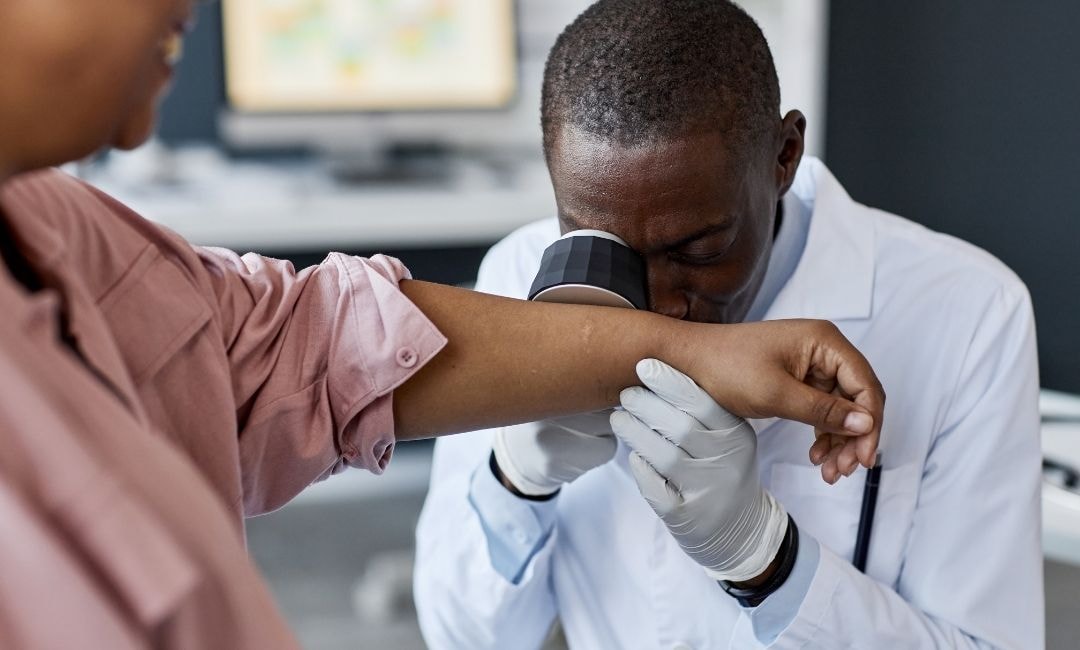
Your provider may use a special magnifying glass with a light to look more closely at certain moles or spots. This tool is called a dermatoscope, and it allows dermatologists to see structures beneath the skin’s surface.
Dr. Richardson at Natura Dermatology uses digital dermoscopy, which captures high-resolution images of suspicious lesions. These photos become part of your permanent record and help track changes over time.
What Dermatologists Look For
During a skin cancer screening, your doctor is checking for the “ABCDEs” of each mole, which are all possible signs of skin cancer:
- Asymmetry
Border irregularity
Color variation
Diameter (larger than 6mm)
Evolving (changing over time)
Your doctor will also check for actinic keratosis, skin changes caused by sun damage that, without treatment, can turn into cancer.
They’ll examine and measure the area you’re concerned about, noting the size, shape, color, and texture of the area in question, and if it is bleeding, oozing, or crusting.
Itching is a common feature that dermatologists take seriously, especially when combined with visual abnormalities.
If Something Looks Suspicious
If your dermatologist finds a suspicious mole or growth, they will determine whether it’s best to monitor it or remove it. They may take photos to aid in monitoring the lesions.
Not every concerning spot gets biopsied immediately. Sometimes dermatologists prefer to watch and wait, documenting the lesion with photography and scheduling a follow-up in 3-6 months.
But when a biopsy is warranted, the procedure that your dermatologist uses to remove the spot is called a skin biopsy. Having a skin biopsy is essential. It’s the only way to know whether you have skin cancer. There’s no other way to know for sure.
If your doctor thinks a mole is a problem, they will give you a shot of numbing medicine, then scrape off as much of the mole as possible. You shouldn’t feel pain, only tugging or pressure.
The biopsy sample goes to a pathology lab where specialists examine it under a microscope. Results typically come back within 7-10 days.
Natura Dermatology performs biopsies in-office with minimal discomfort. The team uses advanced local anesthetics and refined techniques that most patients describe as “barely noticeable.”
After the Screening
Your dermatologist will discuss the evaluation with you once complete. Further exams, a biopsy, or additional testing may be needed if suspicious lesions are found.
Most people walk out with clean bills of health. The vast majority of skin changes aren’t cancer.
Patricia shared the spot that was concerning her. The doctor examined it and assured her it was nothing to worry about. It was dermatitis, an inflammation of the skin. The whole examination took no more than 10 minutes.
But even negative screenings provide value. You’ll know your baseline. You’ll understand which moles to watch. And you’ll have professional documentation of your skin’s current state.
How Often Should You Screen?
On average, we recommend annual TBSEs (total body skin exams). Based on your individual risk factors, personal history, and family history of skin cancer, your dermatologist may request more frequent visits.
High-risk patients might need screenings every 3-6 months. That includes people with:
- Previous skin cancer diagnosis
- Family history of melanoma
- Numerous atypical moles
- History of severe sunburns
- Weakened immune systems
- Fair skin that burns easily
Talk to your doctor about how often you should check your skin. The frequency depends on your unique risk profile.
Between professional exams, monthly self-checks remain your first line of defense. Look for changing moles, new growths, or persistent symptoms like that stubborn itch that won’t quit.
Natura Dermatology & Cosmetics provides comprehensive screening packages tailored to individual risk levels. Their mission goes beyond catching cancer after it develops—they’re committed to preventing skin cancer deaths through thorough imaging, regular monitoring, and patient education.
If you’ve noticed persistent itching, changing moles, or any other skin cancer itchy symptoms, schedule a screening. Early detection transforms outcomes. What might seem like a minor annoyance could be your body’s early warning system, and catching skin cancer in its earliest stages means simpler treatment and better prognosis.
Get Peace of Mind at Natura Dermatology
That itch might be nothing. Or it might be your skin’s way of waving a red flag before anything becomes visible. The difference between dismissing symptoms and getting them checked can literally save your life.
Key takeaways to remember:
- Skin cancer itchy sensations are a common feature in 37% of nonmelanoma skin cancers, especially squamous cell and basal cell carcinoma
- Cancer-related itching persists for 6+ weeks, doesn’t respond to typical treatments, and often appears alongside visual changes
- Look for the whole picture: bleeding that won’t stop, sores that don’t heal, changing moles, and rapid growth
- Family history, previous skin cancer, and multiple warning signs together demand immediate evaluation
- Professional screenings take 10-15 minutes and can catch cancer at its most treatable stage
Dr. Will Richardson and the team at Natura Dermatology & Cosmetics screen hundreds of Fort Lauderdale patients each month, catching suspicious lesions before they become serious problems. Their advanced dermoscopy technology and comprehensive full-body exams mean nothing gets missed.
FAQ
What does the beginning of skin cancer look like?
Early skin cancer often appears as a small pearly bump, a flat scaly patch, or a mole with irregular borders. It might look like a sore that won’t heal, a shiny translucent growth, or a rough, crusty area that bleeds easily.
What does itchy skin cancer look like?
Itchy skin cancer typically shows as a persistent lesion that’s changing, bleeding, or crusting. Basal cell often appears as a pearly bump with visible blood vessels. Squamous cell looks like a rough, scaly red patch. The itch stays localized to the abnormal area.
What are the symptoms of skin cancer?
Common symptoms include new growths, changing moles, sores that don’t heal after weeks, rough scaly patches, persistent itching, spontaneous bleeding, and lesions with irregular borders or multiple colors. Many skin cancers are painless in the early stages.
At what stage does melanoma itch?
Melanoma rarely causes itching and is the least itchy skin cancer (only 15% of cases). When melanoma does itch, it can occur at any stage but often signals immune system activation against cancer cells. Any itchy, changing mole warrants immediate evaluation.


